Feeling the Year-End Pressure? How Stress Shows Up in Your Body and How Acupuncture Can Help
As we approach the final stretch of the year, many of us start to feel the weight of it. Here at our New York CIty location, year-end usually brings a mix of excitement and pressure: holiday planning, end-of-year projects, performance reviews, and bonus deadlines. For others, it’s simply the realization that another year flew by, and we didn’t do everything we hoped to.
At this time of year, I see more NYC professionals coming in with stress-related symptoms, though many don’t even realize that stress is the underlying cause. Once you become aware of the signals and your personal stress thresholds, acting on this information and using acupuncture as part of your stress toolbox is the key to keeping yourself performing at a high level. Our stress treatment is one of the most requested treatments at ArTeva Acupuncture. Let’s dive in…
Building Stress Awareness: Tune In to Your Body’s Signals
Stress can manifest in physical, emotional, and behavioral ways. The first step is to build your awareness so that you can acknowledge when you’re in a stressed state or about to enter one.
It often begins with recognizing initial signals, such as increased breathing and heart rate. Over time, prolonged stress can lead to sensations of feeling overwhelmed, physical tightness (like in your shoulders), a clenched jaw in the morning, or fatigue that lingers even after a “good” night of sleep.
When stress hormones like cortisol stay elevated too long, your nervous system can get stuck in “fight-or-flight” mode, keeping your body alert even when you’re trying to rest. Over time, this tightly wound spring can create deep tension, inflammation, and imbalance across multiple systems—both physical and emotional.
Recognizing and acting on your stress signals is one of the first steps to addressing stress before it gets out of hand. Scan the list below to begin your self-awareness process:
Physical Signs
- Headaches or other body pains
- Muscle tension or stiffness (e.g., shoulders and neck, jaw clenching)
- Feeling wired but tired—running on empty, yet unable to slow down
- Digestive issues, such as stomach aches, constipation, or diarrhea
- Hormonal changes or worsened PMS
- Trouble sleeping or nightmares
- Bloating and cramping
- Increased blood pressure or heart rate
- Getting sick more often
- Insomnia, restlessness at night, and trouble concentrating during the day
Emotional & Behavioral Signs
Emotional Signs
- Irritability, anger, or becoming easily frustrated
- Anxiety, worry, or feeling restless
- Feeling overwhelmed or swamped
- Difficulty relaxing or feeling on edge
- Sudden mood swings
- Apathy, a general sense of dissatisfaction, or lack of interest in hobbies
- Reduced confidence
Behavioral Signs
- Difficulty concentrating or a racing mind
- Changes in eating habits (eating more or less)
- Changes in sex drive
- Social withdrawal or isolating oneself
- Increased use of alcohol or drugs
- Snapping at loved ones
Where Are You on the Stress Curve?
After learning what the signals are, build awareness of positive and negative stress and how long you’ve been in this state.
Positive stress consists of beneficial challenges, like learning something new, starting a new job, or exercising. The key question to ask yourself is: Is this a positive challenge or a negative threat? We need these levels of positive stressors in our lives to provide some level of arousal—otherwise, we risk becoming too inactive.
Negative stress is the more common type we know, with many of the signals discussed above. Many of these trigger types are categorized as “negative threats”. This chart below summarizes the full spectrum of stress. It can be used as a starting point to figure out where you are on in your current stress state.
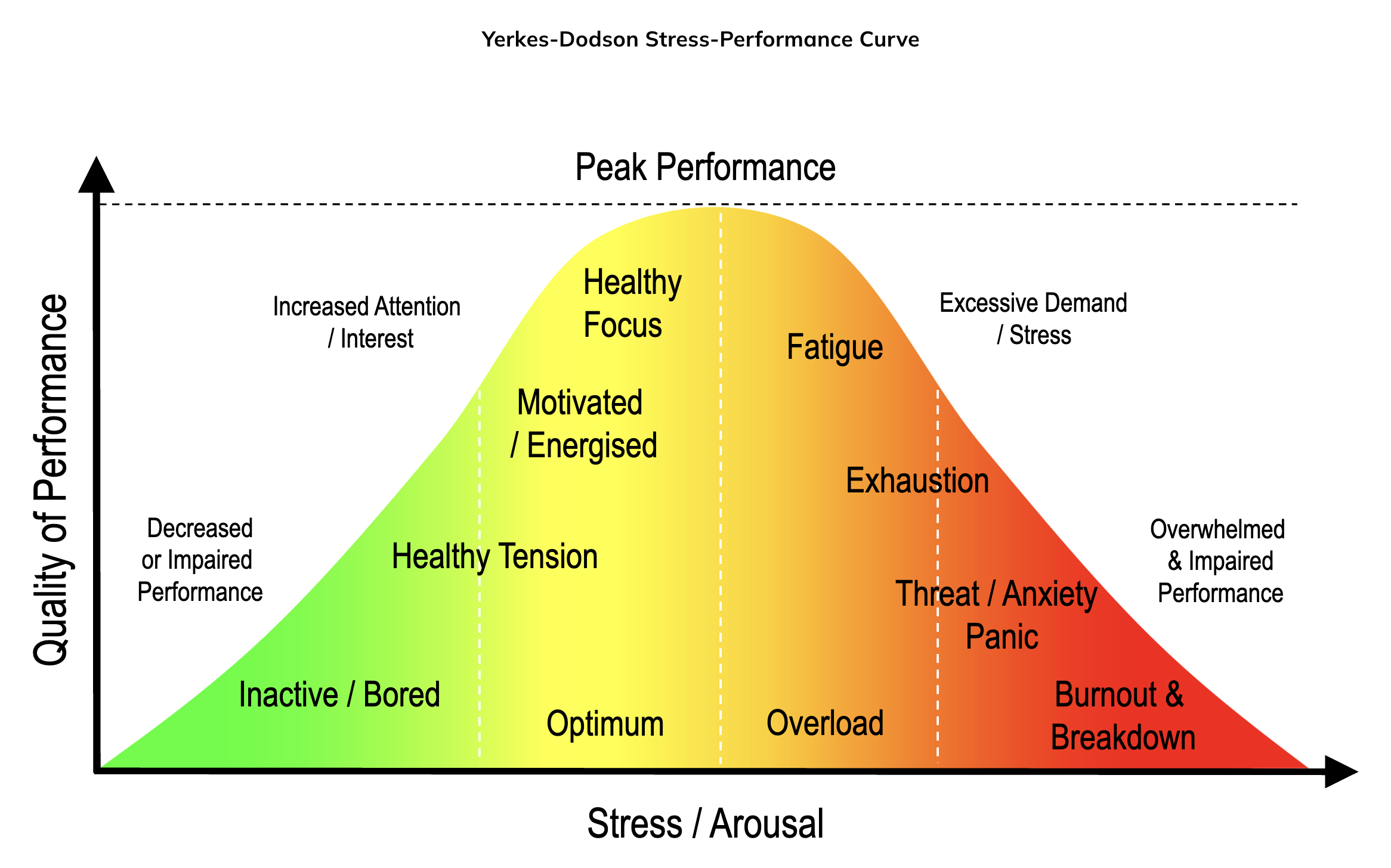
Use performance and emotion as a barometer for determining how much stress you can handle and ask yourself: If there are 10 current identifiable stressors (where 5 are positive and 5 are negative) does your performance and emotion seem okay, or could you use a little (or a lot) of help to get back to balance? Or maybe you have 9 positive stressors and 1 gigantic negative one that’s overshadowing everything, pushing you into the red zone? Or perhaps you have just 1 positive stressor and 9 itty-bitty negative ones, but you still feel fine? Basically, what you consider “red zone” stress is completely individual.
If you’re in the red zone, figure out how long you’ve been there. Are the stressors episodic or a one-time occurrence? How long is too long for you? Has it been 1 week or 1 year? Remember, the longer you spend there, the greater the risk of more serious symptoms in the body.
How Acupuncture Helps Your Nervous System Reset and Deal with Stress
While there are many treatment methods for stress, acupuncture especially Neuropuncture (the neuroscience-based method I use) should also be in your rotation of effective tools.
Think of each treatment as a way to retrain your nervous system. Through gentle, precise stimulation of neurovascular junctions connected to the vagus nerve and brain pathways, acupuncture helps your body remember how to regulate itself again.
It’s not about forcing relaxation; it’s about teaching your system how to find balance on its own.
As the body begins to shift out of constant alert mode, patients often notice:
A deeper sense of calm and mental clarity; most feel relief within 1 - 3 sessions
Reduced muscle tension, especially in the neck, jaw, and shoulders
Better digestion and more regular bowel movements
Fewer headaches and hormonal fluctuations
Improved sleep—falling asleep faster and staying asleep longer
A steadier mood and better resilience to daily stressors
And the best part? It’s all drug-free and works on any part of the stress curve.
Take Action: Prioritize Your Well-Being Now
Stress is a deep and nuanced topic, so it's wise to seek help from the appropriate professional when needed. This post serves as a gentle introduction, offering simple self-analysis tools and guidance on safely incorporating acupuncture as one of your available tools.
Become more proactive with your new stress self-awareness, and don’t wait until burnout or pain forces you to slow down.
If you’ve noticed your energy, sleep, or focus slipping as the year winds down, this is a perfect time to reset your system before the new year begins. Or maybe you’re deep in the red zone and need a jump start to begin your more thorough recovery.
A few well-timed sessions can help your body release built-up stress, improve sleep, and restore that calm, grounded energy you’ve been missing.
If you are in New York City (Manhattan, Brooklyn, Queens) and are feeling the pressure, let’s help your nervous system close this year with balance and start the next one stronger.