Pain Between the Shoulder Blades? What you can do at home
Do you feel a deep, nagging ache along the inner edge of your shoulder blade? Is it worse when you sit at your desk, lift overhead, or carry a heavy bag on one side? That pain you're feeling might be more than just muscle tension.
You could be dealing with Dorsal Scapular Nerve Entrapment — a condition that often goes unrecognized but can seriously affect your comfort and movement.
This post will cover:
· What is Dorsal Scapular Nerve Entrapment
· How to identify the issue
· Jobs/hobbies that commonly trigger this
· What Can You Do - Simple Daily Steps to Start Feeling Better
What Is the Dorsal Scapular Nerve Entrapment? (In Simple Terms)
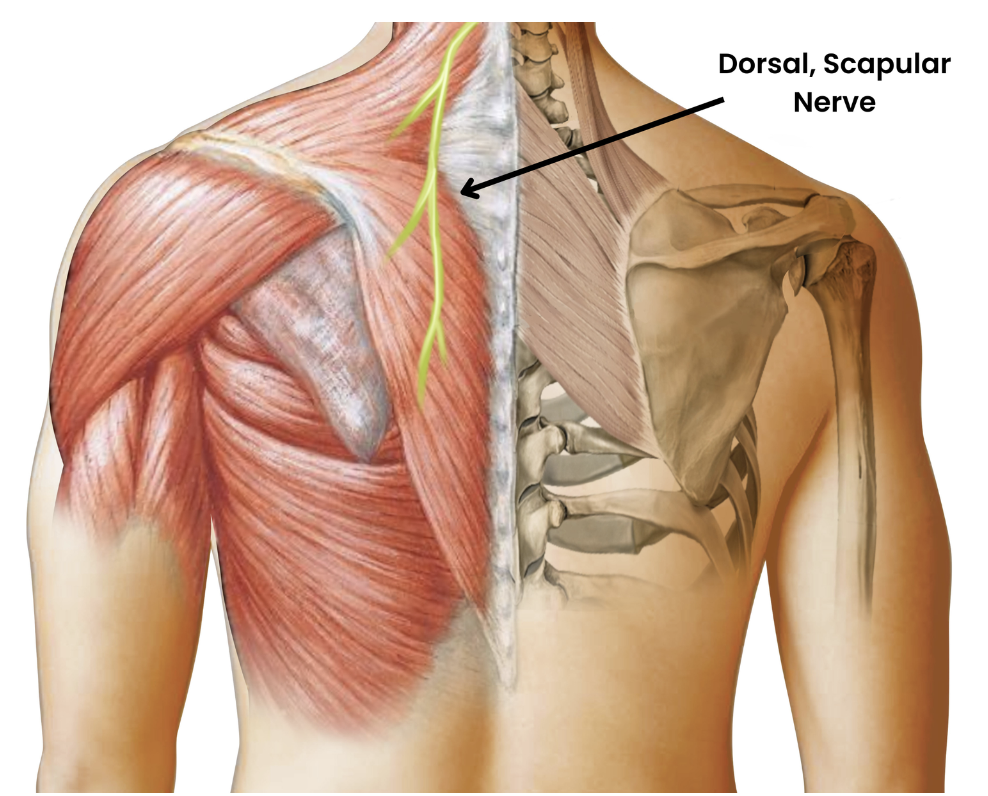
There is a small nerve in your neck called the dorsal scapular nerve that helps control two important muscles in your upper back: the rhomboids and the levator scapulae. These muscles help move and stabilize your shoulder blade (the flat bone that sits on your upper back).
Sometimes, that nerve gets pinched or irritated by tight muscles or repetitive use. When this happens, you may feel:
A deep, aching or burning pain between your shoulder blade and spine
Pain when turning your head, lifting your arms, or carrying bags
Tension that doesn’t fully go away with stretching or massage
Many patients think it is just "back tightness," but it can be a small nerve causing a big problem.
How to Identify the Issue
Deep ache or stiffness on one side between the spine and shoulder blade
Pain that worsens with desk work, driving, or carrying things
Feeling like massage helps temporarily, but the pain keeps coming back
Discomfort when rotating your neck or lifting overhead
Jobs/Hobbies That Commonly Trigger Dorsal Scapular Nerve Entrapment
If your job involves sitting, leaning forward, or repetitive shoulder and neck movements, you may be more likely to develop this type of pain. Activities that we enjoy can also add stress to your upper back and neck, especially when done frequently or without any pre-hobby warm-up stretch. Here are some common examples and how they affect you:
| Jobs / Hobbies | Why It Puts You at Risk |
|---|---|
| Desk Workers / Office Jobs | Prolonged sitting, rounded shoulders, neck strain |
| Surgeons / Dentists | Long procedures with arms and head in fixed positions |
| Photographers / Videographers | Holding equipment for long periods, repetitive angles |
| Hair & Makeup Artists | Arms elevated for much of the day |
| Nurses | Lifting patients, bending and reaching frequently |
| Musicians (String or Wind Instruments) | Fixed posture, tension in shoulders and upper back |
| Construction Workers | Repetitive lifting, reaching, or pulling overhead |
| Long Driving or Commuting | Postural stress, arm position, shoulder compression |
| Tennis / Golf | Repetitive arm swinging, rotation, and shoulder strain |
| Swimming | Constant shoulder and neck movement, tight chest muscles |
| Gym Workouts (Pulling/Lifting) | Overuse of upper back muscles, especially without recovery |
What Can You Do - Simple Daily Steps to Start Feeling Better
These 4 daily practices can help reduce pressure on the dorsal scapular nerve, improve posture, and relieve muscle tension:
Most people unknowingly sit with a forward head and rounded shoulders, which can irritate the dorsal scapular nerve.
Instead:
- Sit upright, feet flat on the floor
- Gently pull your head back so your ears are in line with your shoulders
- Roll your shoulders down and back
- Think: "Head over chest, chest over hips"
Pro Tip
Do this check every 30–60 minutes when sitting at your desk, driving, or scrolling your phone. Set up an alert on your phone as a reminder. Start with frequent checks initially, then gradually increase intervals as the habit builds.
This movement strengthens postural muscles and opens tight areas around your shoulder blades and neck.
How to do it:
- Stand with your back, head, and heels against a wall.
- Raise your arms into a "goalpost" position: elbows bent at 90°, palms facing away from the wall.
- Slowly slide your arms up toward your head, then back down toward your waist, keeping contact with the wall.
- Focus on keeping your spine neutral and not arching your lower back.
Recommended
Do 10 slow reps, 1–2 times per day for maximum benefit.
Great for improving thoracic (mid-back) mobility and relieving tension near the scapula.
How to do it:
- Start on hands and knees.
- Inhale: Arch your back, lift your chest and tailbone (cow pose).
- Exhale: Round your spine, tuck your chin and tailbone (cat pose).
- Focus on moving from your mid-back rather than your low back.
Recommended
Do 10–15 rounds, moving slowly with your breath.
Remember to:
- Stand up and move every 30–60 minutes
- Gently roll your shoulders back and stretch your chest
Why It Matters
Regular movement breaks help reduce pressure on the dorsal scapular nerve, restore proper blood flow, and prevent muscle tightness that can contribute to pain and discomfort.
If after you have done these and find the pain continues, seek a practitioner trained in electro-acupuncture, dry needling, and soft tissue therapy to help identify the root cause and create a treatment plan to decompress the nerve and relieve your symptoms.
Next post, we will cover how acupuncture and dry needling and other modalities can help with Dorsal Scapular Nerve Entrapment.
References
Urits, I., Charipova, K., Gress, K., Patel, M., & Cornett, E. M. et al. (2020). A comprehensive review of the dorsal scapular nerve: Anatomy, clinical implications, and treatment options. Pain Physician, 23(4), E389–E398.
Tubbs, R. S., Salter, E. G., Wellons, J. C., & Blount, J. P. (2005). Dorsal scapular nerve: Anatomy and potential compression sites in the thoracic outlet region. Clinical Anatomy, 18(5), 385–389.
Netter, F. H. (2014). Atlas of Human Anatomy (6th ed.). Elsevier.
Kendall, F. P., McCreary, E. K., Provance, P. G., Rodgers, M. M., & Romani, W. A. (2005). Muscles: Testing and Function with Posture and Pain (5th ed.). Lippincott Williams & Wilkins.
Page, P., Frank, C., & Lardner, R. (2010). Assessment and Treatment of Muscle Imbalance: The Janda Approach. Human Kinetics.
Simons, D. G., Travell, J. G., & Simons, L. S. (1999). Myofascial Pain and Dysfunction: The Trigger Point Manual, Volume 1. Williams & Wilkins.
Gombatto, S. P., et al. (2008). Differences in lumbar spine posture and movement patterns during sitting between people with and without low back pain. Physical Therapy, 88(10), 1100–1112.
Muscolino, J. E. (2015). The Muscular System Manual: The Skeletal Muscles of the Human Body (4th ed.). Elsevier.